

Early treatment, IMO was important & critical 'EARLY' on, in sick, high-risk & elderly persons, I believe IVM & HCQ had a place, with legacy 'whatever it was' they cooked up & released, the antibiotic
the antibiotics IMO were the key and maybe critical & maybe ONLY part of early treatment that was beneficial across this respiratory entity (ILI), I believe early treatment WAS/IS abused, wrongfully

I believe many are prostituting IVM and HCQ…and they know it….they know it has no role in low-risk healthy people it has no benefit. IMO.
IVM and HCQ are important and should always be in your medicine chest (as anti-helminths, anti-parasitic with drugs like albendazole etc. as anti-malarials, anti-lupus, anti-osteo-arthritis etc. and have been shown to be safe and effective across near 70-80 years) and I do fully support The Wellness Company’s (TWC) Emergency Preparation Kit, it is not a pandemic kit, the pandemic was a fraud, it never was, this Kit has principally prescription antibiotics we could not even get when the malfeasants subjected us to the fraud fake non-pandemic…so in this I love Coulson’s vision…excellent and I support it as an emergency prep kit, and think you need this kit as an Emergency Preparation Kit…to have on hand. As well you could chose not to get it. You should IMO always find a way to conjure up your own emergency prep kit (get what you think is going to be beneficial) for your homes…and keep it there for what we saw is governments and the malfeasants then deny you access to things you would normally have access too…as they restrict and lock us down etc.
Do not think they will not do this or try again? question is, would we let them? what would we do this time?
I believe:
1)Dr. Peter and Ginger Breggin and folk like Ruby etc. were maligned and damaged by Malone wrongfully and he should pay them financially! Thank God for some sane judges now! Breggins remain the real Freedom Fighters day one and I am proud to call them my friends. What Malone tried to do to them was monstrous and he did not realize Peter Breggin is a fucking beast of a man, true American patriot, sage, potent, powerful and will fight and put down frauds like Malone 24/7…long live Breggins!
2)there never a COVID pandemic, it was a lie; a lie that helped them steal power, amass power, steal our liberty and freedom, steal 5 to 6 trillion $ transfer it to the wealthy form the poor and middle class; they shifted morbidity and mortality burden to the poor for the poor were not able to shield
3)that asymptomatic spread was a 100% lie
4)that recurrent infection pre-Omicron was a lie
5)there was NEVER equal risk of severe outcome told to us by CDC, NIH, Health Canada, PHAC, et.c day one and was a lie for 10 year old healthy Johnny could not be at same risk as 85 year old granny with underlying medical conditions when you do not take his age and baseline risk (none) into account; a 100% lie that doomed and hobbled the response for this scared people…
5)that antibiotics (if only) was the key and maybe main and maybe ONLY part of early treatment AFTER the critical ‘early’ phase of this lie…that nothing else was needed outside of antibiotics for pulmonary infection, pneumonia in high-risk persons…IMO…that your natural immunity, you, your immune system dealt with whatever this was and recovered you…nothing else…
6)that it was not even an emergency…had we done NOTHING, no one would have noticed
7)that whatever they cooked up and released as IMO a binary or tertiary type bioweapon to depopulate, yes, to depopulate, to cull, was released just after 2015 (intent or not) and was always circulating (they likely placed it there and so I ascribe to Couey’s infectious clone hypothesis as likely explanation and I am putting a time stamp on it as to 2015 or so) and in fact, the globe was largely already immune
8)they used a fraud overcycled PCR ‘process’ (beyond 24 amplifications that meant viral dust and fragments and non-infectious non-lethal pathogen) to detect something that was ‘always’ there…benign, they knew this, for they put it there…PCR was part of the entire fraud lie…this fraud fake pandemic was based on 2 key lies, PCR positive which was 95% false-positive and the lie of asymptomatic spread. They had to sell it and they sold it…you bough it!
9)this was a ‘95% ‘false-positive’ over-amplified PCR-manufactured fake fraud non-asymptomatic spread, NON-pandemic…it never ever was a pandemic…they created a pandemic out of fear and NOTHING!
10)had we done NOTHING, nothing, just protect elderly as usual, commonsense precautions whenever something possibly toxic comes around, we would have killed far fewer
11)I believe the Malone and Weissman and Kariko et al. mRNA technology is the basis within the mRNA COVID vaccines, and as part of the LNP ‘fatty lipid ball’ exosome extra-cellular vehicle type transpost complexes, KILLED people…I believe Malone, Weissman, Bourla (Pfizer), Bancel (Moderna), Kariko, Sahin (BioNTech) et al. must answer for murder in proper courts with proper juries and judges…proper fair legal inquiries but must be held for murder, murder in the ‘FIRST’…they knew…
12)I believe that it is the medical management (COVID health policies), the lockdown lunacy, but the medical management of our peoples is what killed the VAST majority (many also died due to denial of treatment when hospital beds were designated as ONLY COVID beds for 2 years and they progressed to severe heart disease, cancer, diabetes sequelae etc.), and the mRNA COVID Malone and Bourla vaccine injection that killed, and the collaterol damage from the lockdowns and school closures, yes, these killed, the non-pharmaceutical interventions (NPIs) that also killed and placed sub-optimal ‘non-lethal’ natural selection pressure on pathogen along with the non-neutralizing, non-sterilizing selective pressure on the mRNA vaccine (as one explanation too); but indeed, it was the medical management, how we badly abused and treated our high-risk peoples, in hospitals, in nursing homes, that KILLED the vast majority, mabye 80-90%…it is
those who brought this COVID lie and deadly mRNA technology and mRNA vaccine and suffered our elderly and high-risk in fear. In the first place. These evil fuckers
isolated granny and had her cowering in fear, these evil bitches refusing to touch her,
had granny laying in her feces and urine, her piss for weeks as she spiralled down and died, maggots all over her, but these fuckers till got the COVID protocol cheque…
dehydrated her,
malnouriched her,
placed DNR orders on her illicitly, did not tell the family
denied her antibiotics she badly needed, when bacterial pneumonia secondary to viral infections were the greatest cause of death (when you lay down an elderly or anyone for days, weeks)
sedated her with deadly toxic drugs like propofol, midazolam, lorazepam, fentanyl, diamorphine etc.), knowing her breathing was already suppressed and these toxic drugs suppressed her breathing even more
pumped her with kidney and liver toxic Malone failed Ebola Remdesivir,
and then placed the nail in the coffin with the intubation and ventilator that blew up her lungs already under so much trauma, ventilator associated pneumonia (VAP),
and then these fuckers, the evil fuckers told us we could not even see the dead body they killed, we could not even bury her or grandpa, our parents,..we had to partake in a ‘drive by’ funeral.
and your bitch ass wants AMNESTY?
Emergency Preparedness kit of 8 essential medications to have on hand:
kit seen here:
Link:
https://www.twc.health/products/emergency-preparedness-kit?ref=Paul
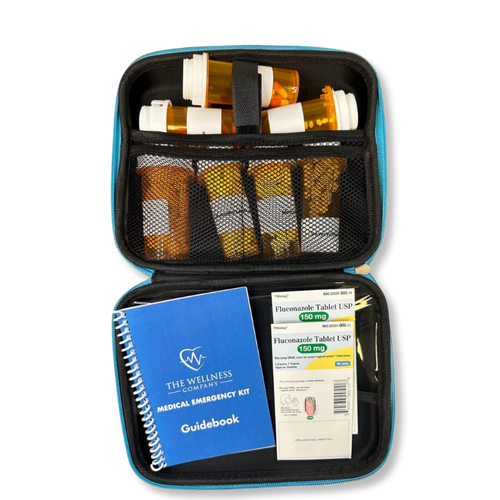
· Amoxicillin-Clavulanate (generic AugmentinTM) 875/125 mg - 28 tablets
· Azithromycin (generic Z-PakTM) 250 mg - 12 tablets
· Doxycycline Hyclate 100 mg - 60 capsules
· Metronidazole (generic FlagylTM) 500 mg - 30 tablets
· Ivermectin (generic StromectolTM) 12mg - 25 compounded capsules/tablets
· Trimethoprim-Sulfamethoxazole (generic BactrimTMDS) 800/160 mg - 28 tablets
· Fluconazole (generic DiflucanTM) 150 mg - 2 tablets
· Ondansetron (generic ZofranTM) 4mg - 6 tablets
· Medical Emergency Guidebook (1) Educational resource developed by our Chief Medical Board for safe emergency use.
The Wellness Company’s Medical Emergency Kit provides broad-spectrum treatment options for a wide range of medical complications.
Face health emergencies with confidence and clarity, using our included Medical Emergency Guidebook.
· Anthrax
· Babesiosis
· Bacterial Vaginosis
· Bartonella
· Bite Wounds (human & animal)
· Bronchitis
· Chlamydia
· Clostridioides difficile
· Colitis
· COVID-19
· Diabetic foot infection
· Giardiasis
· Hookworm
· Lice
· Lyme Disease
· Nausea & Vomiting
· Pertussis
· Q-fever
· Pharyngitis
· Pinworms
· Plague (bioterror)
· Pneumonia
· Rickettsial Infections
· Rocky Mountain Spotted Fever
· Scabies
· Sexually transmitted infections
· Shigellosis
· Sinusitis
· Skin & soft tissue Infection
· Strepthroat
· Tetanus
· Tonsillitis
· Traveler's Diarrhea
· Trichomoniasis
· Tularemia (bioterror)
· Typhus
· Urinary Tract Infection
· UVaginal Candidiasis (yeast infection)
· Viral Upper Respiratory Infection
https://www.ncbi.nlm.nih.gov/pmc/articles/PMC8875017/ Published online 2022 Feb 21
Abstract - Many studies have confirmed the important roles of nutritional status and micronutrients in the COVID-19 pandemic. Magnesium is a vital
essential trace element that is involved in oxidative stress, inflammation, and many other immunological functions and has been shown to be
associated with the outcome of COVID-19 infection.
https://pubmed.ncbi.nlm.nih.gov/32708526/ 2020 Jul 16
Abstract - SARS-CoV-2 infections underlie the current coronavirus disease (COVID-19) pandemic and are causative for a high death toll particularly
among elderly subjects and those with comorbidities. Selenium (Se) is an essential trace element of high importance for human health and
particularly for a well-balanced immune response. The mortality risk from a severe disease like sepsis or polytrauma is inversely related to Se
status.
https://pubmed.ncbi.nlm.nih.gov/34836309/ 2021 Nov 12
Results: Our treatment protocol increased the serum 25OHD levels significantly to above 30 ng/mL within two weeks. COVID-19 cases (no
comorbidities, no vitamin D treatment, 25OHD <30 ng/mL) had 1.9-fold increased risk of having hospitalization longer than 8 days compared with the
cases with comorbidities and vitamin D treatment. Having vitamin D treatment decreased the mortality rate by 2.14 times. The correlation analysis
of specific serum biomarkers with 25OHD indicated that the vitamin D action in COVID-19 might involve regulation of INOS1, IL1B, IFNg,
cathelicidin-LL37, and ICAM1.
Conclusions: Vitamin D treatment shortened hospital stay and decreased mortality in COVID-19 cases, even in the existence of comorbidities. Vitamin
D supplementation is effective on various target parameters; therefore, it is essential for COVID-19 treatment.
https://pubmed.ncbi.nlm.nih.gov/25050823/ 2014 Jul 31
Zinc ionophore activity of quercetin and epigallocatechin-gallate: from Hepa 1-6 cells to a liposome model.
Abstract - Labile zinc, a tiny fraction of total intracellular zinc that is loosely bound to proteins and easily interchangeable, modulates the
activity of numerous signaling and metabolic pathways. Dietary plant polyphenols such as the flavonoids quercetin (QCT) and epigallocatechin-gallate
act as antioxidants and as signaling molecules. Remarkably, the activities of numerous enzymes that are targeted by polyphenols are dependent on
zinc. We have previously shown that these polyphenols chelate zinc cations and hypothesized that these flavonoids might be also acting as zinc
ionophores, transporting zinc cations through the plasma membrane. To prove this hypothesis, herein, we have demonstrated the capacity of QCT and
epigallocatechin-gallate to rapidly increase labile zinc in mouse hepatocarcinoma Hepa 1-6 cells as well as, for the first time, in liposomes. In
order to confirm that the polyphenols transport zinc cations across the plasma membrane independently of plasma membrane zinc transporters, QCT,
epigallocatechin-gallate, or clioquinol (CQ), alone and combined with zinc, were added to unilamellar dipalmitoylphosphocholine/cholesterol
liposomes loaded with membrane-impermeant FluoZin-3. Only the combinations of the chelators with zinc triggered a rapid increase of FluoZin-3
fluorescence within the liposomes, thus demonstrating the ionophore action of QCT, epigallocatechin-gallate, and CQ on lipid membrane systems.
The ionophore activity of dietary polyphenols may underlay the raising of labile zinc levels triggered in cells by polyphenols and thus many of
their biological actions.
https://www.ncbi.nlm.nih.gov/pmc/articles/PMC8573830/ Published online 2021 Aug 30
Abstract - While there was no difference between the groups in terms of event frequency, QCB supplement group had more advanced pulmonar findings,
and QCB supplement is shown to have a positive effect on laboratory recovery/results. Therefore, we conclude that further studies involving
different doses and plasma level measurements are required to reveal the dose/response relationship and bioavailability of QCB for a better
understanding of the role of QCB in the treatment of SARS CoV-2.
https://pubmed.ncbi.nlm.nih.gov/33509217/ 2021 Jan 28
Abstract - Quercetin is a carbohydrate-free flavonoid that is the most abundant flavonoid in vegetables and fruits and has been the most studied to
determine the biological effects of flavonoids. Inflammasomes are cytosolic multi-protein complexes assembling in response to cytosolic PAMP and
DAMPs, whose function is to generate active forms of cytokines IL-1β and IL-18. Activation or inhibition of the NLRP3 inflammasome is affected by
regulators such as TXNIP, SIRT1 and NRF2. Quercetin suppresses the NLRP3 inflammasome by affecting these regulators. Quercetin, as an
anti-inflammatory, antioxidant, analgesic and inflammatory compound, is probably a potential treatment for severe inflammation and one of the main
life-threatening conditions in patients with COVID-19.
https://www.ncbi.nlm.nih.gov/pmc/articles/PMC8197660/ Published online 2021 Jun 8.
Abstract - Quercetin, a well-known naturally occurring polyphenol, has recently been shown by molecular docking, in vitro and in vivo studies to be
a possible anti-COVID-19 candidate. Quercetin has strong antioxidant, anti-inflammatory, immunomodulatory, and antiviral properties, and it is
characterized by a very high safety profile, exerted in animals and in humans. Like most other polyphenols, quercetin shows a very low rate of oral
absorption and its clinical use is considered by most of modest utility. Quercetin in a delivery-food grade system with sunflower phospholipids
(Quercetin Phytosome®, QP) increases its oral absorption up to 20-fold.
Results - The results revealed a reduction in frequency and length of hospitalization, in need of non-invasive oxygen therapy, in progression to
intensive care units and in number of deaths. The results also confirmed the very high safety profile of quercetin and suggested possible
anti-fatigue and pro-appetite properties.
Conclusion - QP is a safe agent and in combination with standard care, when used in early stage of viral infection, could aid in improving the
early symptoms and help in preventing the severity of COVID-19 disease. It is suggested that a double-blind, placebo-controlled study should be
urgently carried out to confirm the results of our study.
Yes the Breggins are National Treasures! God bless them both.