The 'fragility index' in clinical research statistical analysis provide is an intuitive measure of the robustness of study findings; we at McMaster proposed this lead by Dr. Walsh, a friend, bright
scientist, showed that moving just one/two events across trial arms can nullify findings & that the results of trials where outcome event number is small must be interpreted with caution, as FRAGILE


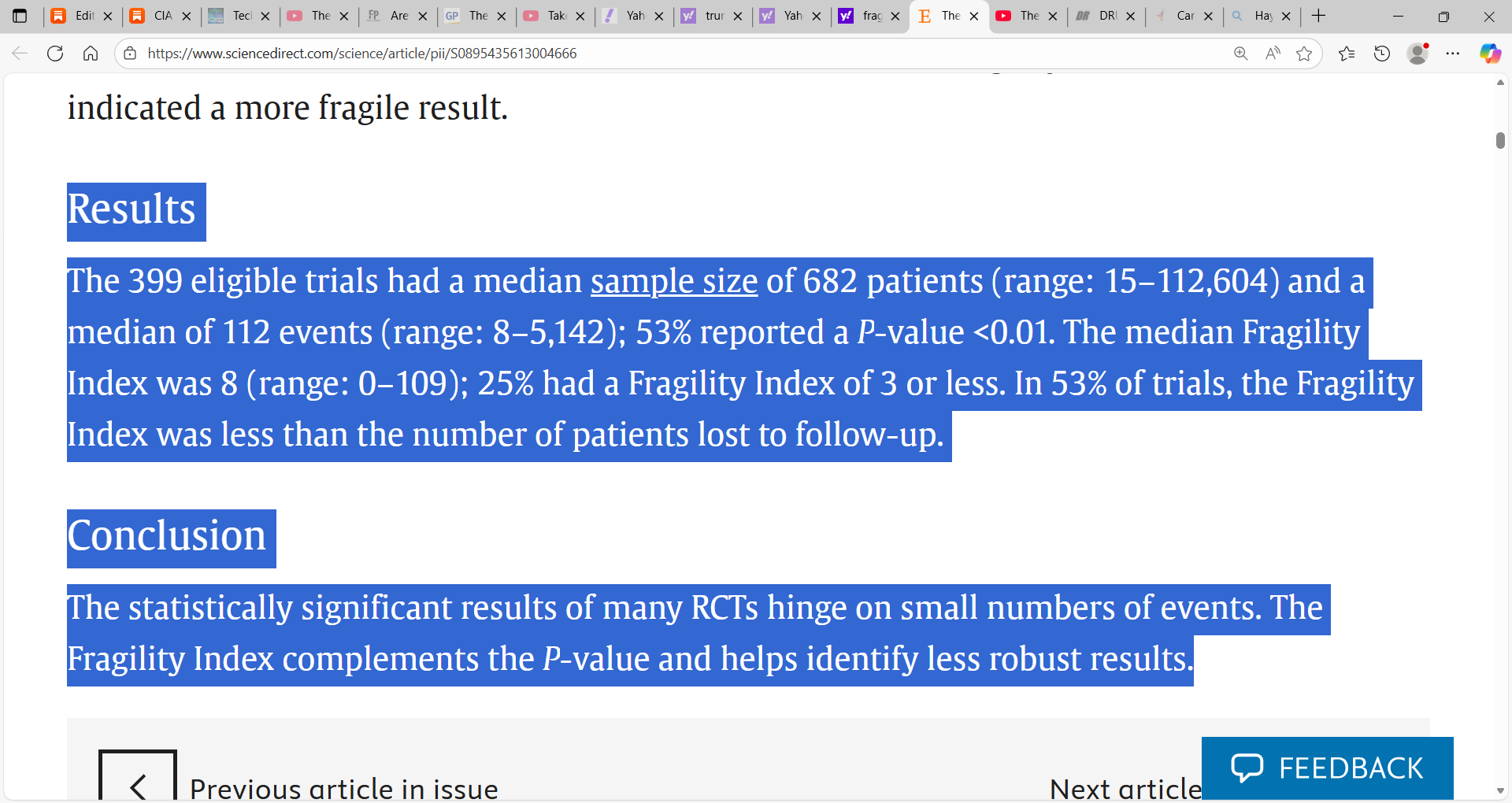
~The minimum number of patients whose status would have to change from a nonevent to an event required to turn a statistically significant result to a nonsignificant result…’The Fragility Index (FI) and Reverse Fragility Index are powerful tools to supplement the P value in evaluation of randomized clinical trial (RCT) outcomes. These metrics are defined as the number of patients needed to change the significance level of an outcome.’ It is usually very small indeed. Can even be one.
‘A P-value <0.05 is one metric used to evaluate the results of a randomized controlled trial (RCT). Fragility Index shows us how often statistically significant results in RCTs may be lost with small changes in the numbers of outcomes. Very potent and alarming. Given many published RCTs that policy is based on have very small numbers of outcome events (and a fragility index at 1 or 2, where loss of one outcome can change the result).
Key points to remember:
•
‘Metrics exist, most notably p-values and 95% confidence intervals, to help determine how likely observed treatment effects are on the basis of chance (is due to chance alone or something other than ‘chance’ has contributed to the findings).
•
A shift of only a few events in one group could change typical hypothesis tests above the usual thresholds considered statistically significant.
•
The Fragility Index helps identify the number of events required to change statistically significant results to non-significant results.
•
The Fragility Index demonstrate results from randomized controlled trials in high impact journals frequently hinge on three or fewer events.’
When interpreting trial results where the number of outcome events is small, be careful as to conclusions as fragility index may play a prominent role and can possibly and usually can reverse the findings (make it uninterpretable) if outcome event number is small.
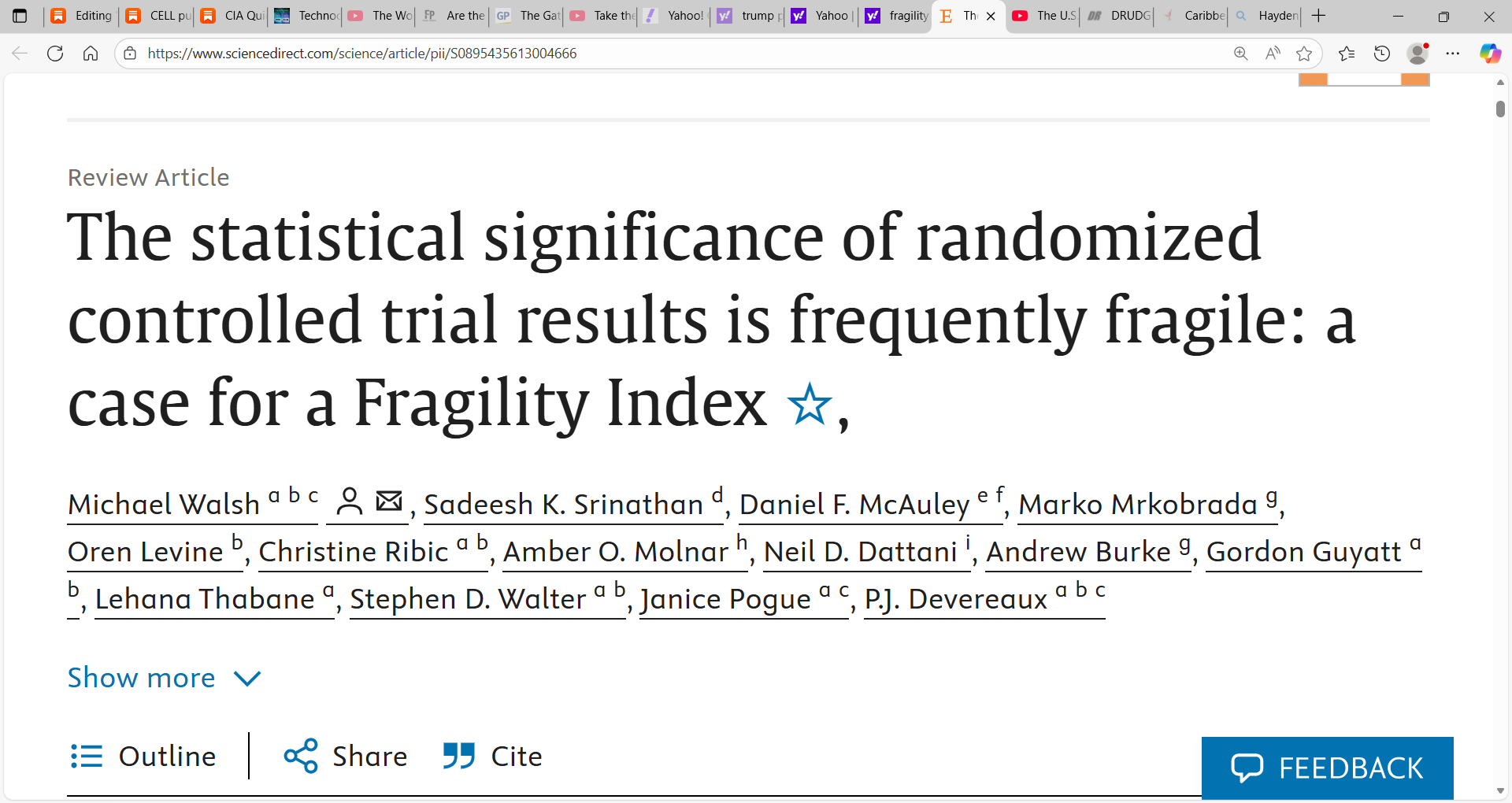
The statistical significance of randomized controlled trial results is frequently fragile: a case for a Fragility Index☆,
Retire statistical significance.
https://media.nature.com/original/magazine-assets/d41586-019-00857-9/d41586-019-00857-9.pdf
krissaj51f.substack.com/p/a44